I used to think marketing was about being creative. Having great ideas. Coming up with a hook that nobody else had thought of.
It took me a few years and a lot of campaigns to figure out that I was completely wrong. Marketing isn’t about creativity. It’s about process. And nowhere is that more true than cold email.
Let me tell you about an SEO agency I worked with that proves this point better than any abstract argument could.
The Agency That Went From $15K to $65K Per Month
When this agency came to me, they were doing $15,000 per month in recurring revenue. Solid foundation, real service, but stuck. They’d tried a few outbound campaigns here and there, nothing consistent, nothing that moved the needle in a meaningful way.
We built out a cold email system together. Not complicated. One channel. No paid ads, no LinkedIn automation running in parallel, no content strategy, no cold calling on top of it. Just cold email, done right.
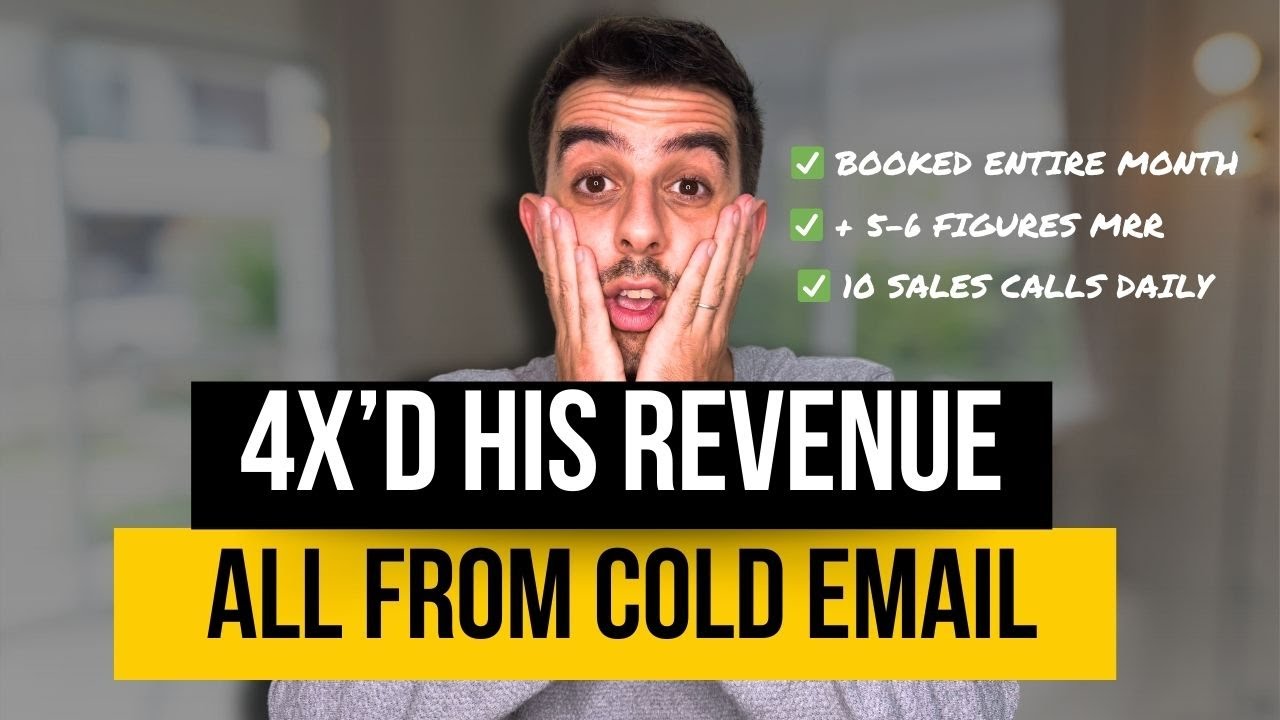
Six months later, they were at $65,000 per month. That’s $50,000 in new monthly recurring revenue added from essentially a standing start. More than quadrupling revenue in half a year, with a single outbound channel.
At peak, they were booking 10 to 12 sales calls per day. Their calendar was booked out three solid weeks.
I’m going to walk you through exactly what we did, specifically the three lessons that drove those results. But I want to start with the lesson that underpins everything else, because without it, the other two don’t work.
The Lesson That Changed How I Think About Cold Email
Here’s the mistake I see almost every agency owner make: they write one email, they send it to their list, and they treat the results as signal.
“It didn’t work. Cold email doesn’t work for our industry.” Or maybe, “It kind of worked: we got a few responses, but nothing consistent.”
And then they either give up or they go write another single email and repeat the experiment.
That’s not a strategy. That’s hope. And hope is not a repeatable system.
The mental shift that unlocked everything for this SEO agency was this: the data should tell you what to write, not your opinions.
You don’t know which angle will resonate with your ideal prospect. Neither do I. Neither does anyone. The only way to find out is to test. And if you test systematically enough, with enough variations, at enough volume, over enough time, it becomes essentially impossible to fail. You force the market to tell you what works.
That’s the core philosophy behind every campaign I run through the Revenue On Demand Engine. Test enough variations, and the winners always surface.
Lesson 1: Always Be Running Multiple Variations
This is where most people stop reading, because it sounds like more work. But bear with me.
This SEO agency ran three to five different email campaign variations simultaneously. Always. Not sequentially, simultaneously. At any given point, we had multiple angles running against the same list.
The metric we optimized for wasn’t open rate. It wasn’t click rate. It was leads generated. How many conversations did this campaign start that turned into real sales opportunities? That’s the only number that matters in an outbound system.
What we were testing:
- Angles, the core positioning of the problem and solution
- Hooks, the opening line that either earns attention or gets deleted
- CTAs, the ask at the end of the email
- Lead magnets, which offer got the most people to raise their hand (more on this in a moment)
- Prospect segments, were we targeting the right kind of company for each angle?
Over weeks, the process was: keep the winners, kill the losers, iterate. The campaigns generating leads kept running. The ones that weren’t generating leads got shut down and replaced with new variations.
After a few months of this, something interesting happened. We stopped having to test as aggressively because we had two campaigns that were consistently performing. Those became the workhorses: we scaled their volume and kept two to three new variants running alongside them to continue finding better angles.
But here’s the key insight: we never would have found those workhorses without running the losers first. Every underperforming campaign was data. Every non-response was telling us something about what not to say.
If you’re running one email at a time, you’re flying blind. You don’t know if the angle was wrong, the hook was wrong, the CTA was wrong, or the list was wrong. With multiple variants, you can start to isolate variables and actually learn something.
Lesson 2: Personalization That Makes Prospects Feel Seen
Generic outreach has a low ceiling. I’ve seen it thousands of times.
“We do SEO for companies like yours. Would love to show you what we can do.” That email gets ignored. Not because the offer is bad, but because it treats the prospect as one of many, not as a specific person with specific problems.
What this agency learned to do instead was lead with something specific to the prospect’s actual situation. Not flattery. Not fake research. Genuine relevance.
Instead of “We do SEO,” the email became: “I noticed your website’s title tag for [specific page] isn’t targeting the keyword your competitors are ranking for. This is a quick win worth fixing: here’s what I mean.” That’s a completely different opening. Now the prospect isn’t reading a pitch. They’re reading a diagnosis. And when your diagnosis is accurate, they want the prescription.
The second piece was the free audit offer. This is where the campaign really took off.
Instead of asking for a call directly, the email offered a free website SEO audit, a genuine review of their site with specific, actionable findings. This did something important: it dramatically lowered the friction to respond. A call is a commitment. An audit is a gift.
The cold email became a referral to the audit, not a sales pitch. And the audit became the sales conversation, because by the time we were walking through the findings, the prospect had already seen competence demonstrated. The close happened naturally.
This is the kind of high-value lead magnet approach I write about in more depth on the cold email outreach page, if you want to understand the full framework, start there.
Lesson 3: Master One Channel Before You Expand
Here’s something I want to be direct about, because I see the opposite mistake everywhere.
This SEO agency was doing cold email only. Not cold email plus LinkedIn plus paid ads plus referrals plus content plus SEO. Just cold email. And they went from $15K to $65K per month with that one channel.
The most common outbound mistake I see from agency owners and B2B founders is spreading thin across ten channels and being mediocre at all of them. They try cold email for two weeks, LinkedIn DMs for a month, throw some budget at ads, start posting content, and they’re not giving any channel the time and focus it needs to compound.
Every channel has a learning curve. Cold email in particular requires iterating through enough campaigns to understand your market, your messaging, and your list. If you’re splitting your attention and your volume across multiple channels, you’re extending that learning curve indefinitely. You never get good at any of them.
Pick one. Go deep. The data compounds over time as you learn what works. Once you’ve built a machine on one channel, once it’s running consistently, predictably producing leads without requiring constant intervention, then you can think about adding a second channel on top of a solid base.
You can build a six or seven-figure business with cold email alone, if you do it right. This agency proved that. I’ve seen it happen across dozens of clients. The constraint isn’t the channel. It’s the depth of commitment to doing the channel well.
What “Process-Driven” Actually Means
I want to come back to the idea I opened with, because I think it’s worth sitting with.
When I say marketing is about process, not creativity, I’m not saying creative copy doesn’t matter. The angles we tested mattered. The hooks we tested mattered. The language we used mattered enormously.
What I’m saying is that the source of your winning creative should be data, not inspiration. The SEO agency’s best-performing campaigns weren’t the ones anyone thought would work best. They were the ones the market chose through their response patterns. The data told them what to write. Their opinions were just hypotheses waiting to be tested.
That’s what process-driven looks like in practice. You form hypotheses (campaign variations). You test them with sufficient volume. You let the results tell you which hypotheses were right. You iterate.
You don’t need great ideas. You need a great testing process. Given enough variations and enough time, the right ideas emerge from the data. You make it impossible to stay stuck, because you’re systematically eliminating what doesn’t work and scaling what does.
Putting It Together
If you want to build a cold email system that grows like this SEO agency’s did, the blueprint isn’t complicated:
- Build an offer that has a genuine lead magnet, something prospects want to receive, not just a pitch disguised as value.
- Launch three to five campaign variations simultaneously from the start, testing different angles and hooks.
- Optimize for leads generated, not open rate.
- Keep the winners, kill the losers, iterate.
- Go deep on cold email before layering in anything else.
That’s the system. It’s not glamorous. It doesn’t require brilliant creative thinking or a breakthrough idea. It requires consistency, volume, and a commitment to letting the data guide the decisions.
If you want help building this kind of outbound system for your business: the targeting, the sequences, the A/B testing infrastructure, and the offer, take a look at how we approach outbound strategy, or book a call and we’ll walk through what your specific situation calls for.
The agencies winning right now aren’t the ones with the cleverest emails. They’re the ones running the most systematic campaigns. And that’s something anyone can build.
Watch Our Free Training
See the exact outbound system used across 600+ campaigns - no opt-in required.
Free Strategy Call
Ready to Build Predictable Revenue?
Book a free 1-on-1 strategy call and we'll map out a custom outbound plan for your business.
Book a Free Growth Call