Over 12 years working with 400+ B2B clients across tech startups, SaaS, agencies, consulting, and professional services, I’ve watched the same GTM mistake play out at every revenue stage.
A founder or growth team looks at their marketing options, cold email, LinkedIn, YouTube, podcasts, Google ads, Meta ads, SEO, PR, partnerships, and gets completely overwhelmed. So they either try everything at once and spread themselves too thin, or they pick whatever feels most familiar and wonder why it’s not producing.
Here’s the clarity I wish everyone started with: every B2B growth channel fits into one of three buckets. Once you understand the buckets, and more importantly, the order to work through them, the overwhelm disappears.
The Three Buckets
Outbound is where you start the conversation. You identify a prospect, you reach out, you initiate. Cold email, LinkedIn outreach, cold calling, these are all outbound. You’re going to them.
Inbound is where the prospect comes to you, typically through content. LinkedIn content, YouTube, a podcast, a blog, SEO: these build an audience that finds you, consumes your thinking, and eventually raises their hand.
Paid is where you pay for attention. Google ads, Meta ads, LinkedIn ads. You’re renting an audience rather than building one.
Every channel you’ve heard of fits into one of these three buckets. The question isn’t which bucket to use. The question is which bucket to start with, and in what order to layer the rest.
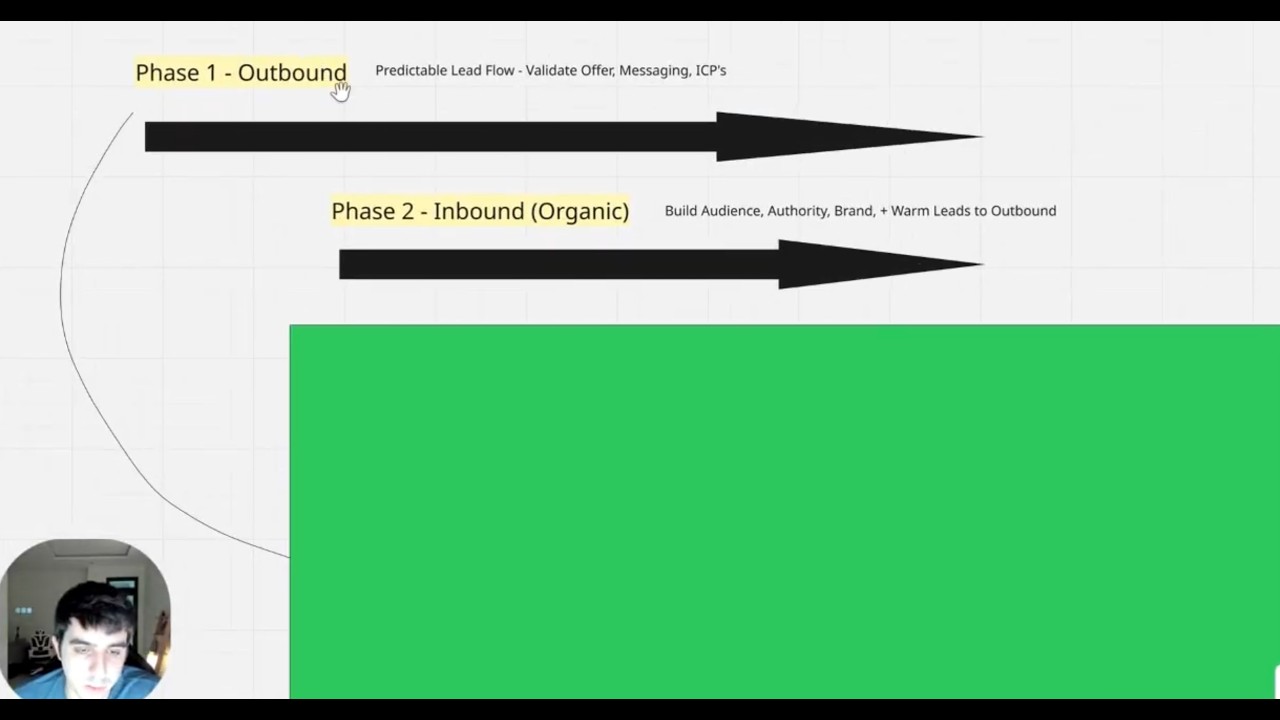
Phase 1: Outbound First
Outbound is always phase one. This is non-negotiable for most B2B companies at the $500K–$5M ARR stage.
The reason isn’t just speed, though speed matters. Outbound with cold email is the fastest way to generate qualified pipeline without significant capital outlay. You can start a basic outbound system for around $200–300/month and be booking calls within weeks.
The deeper reason is learning. When you run outbound campaigns, the market tells you things immediately. Which ICP sub-segments actually reply. Which problem framing resonates. Which offer generates interest versus polite declines. Which objections keep coming up, and what those objections reveal about gaps in your positioning.
Cold email is the cheapest market research you’ll ever run. Every reply, every “not interested,” every ignored sequence is data about whether your message is landing and with whom. That data is invaluable, and you can’t get it from a content calendar or an ad account.
Most founders skip this and go straight to paid. They burn $5,000–10,000 per month on ads, get mediocre results, and blame the channel. The channel isn’t wrong. The message is wrong. They just haven’t done the reps to know it yet. Outbound would have told them in week three for a fraction of the cost.
This is the core of what I call The Revenue On Demand™ Engine: validate your ICP, offer, and messaging through outbound before you invest in anything else.
Phase 2: Inbound Organic
Once outbound is generating predictable pipeline and you know what’s working, it’s time to start building your inbound presence.
Inbound serves a different purpose than outbound. It’s not fast: building an audience on LinkedIn, YouTube, or a podcast takes months before it compounds. But once it’s running, it creates something outbound alone can’t: warm leads.
When someone has been following your content for six months before they ever talk to you, the sales conversation is completely different. They’ve already decided. They’re not evaluating whether you know what you’re talking about: they’ve been consuming your thinking for months and they’ve answered that question for themselves. They’re calling to confirm pricing and process, not to be convinced.
I’ve had someone buy a $10,000 consulting package over text message without ever getting on a call, because they’d been following my content for years. That’s the compounding effect of inbound. The close rate goes up, the sales cycle shortens, and the price sensitivity drops.
The other advantage: when you’ve already done outbound and know what resonates, your content isn’t guesswork. You write about the objections you hear in reply emails. You make videos about the problems your best clients brought to you. You address the questions that came up on sales calls. Your inbound content becomes a direct answer to what your market is actually asking, not what you assume they care about.
That sequencing matters. Most people build content before they’ve done outbound, which means they’re guessing at what the market wants to hear. Outbound first gives you the roadmap.
Phase 3: Paid
Paid comes last. This confuses people, because paid feels like the fastest lever: you spend money, you get attention, you get leads. And that’s true, once you know what works.
The problem is that paid amplifies what you put in. If you put in a validated message, a proven offer, and a sharp ICP, paid scales that. If you put in assumptions, paid scales your burn rate.
Think about what paid channels actually require to work: a clear audience definition, a message that converts, an offer they’ll respond to. How do you know those things before you’ve done outbound and built some inbound? You don’t. You’re guessing. And guessing at $10K/month in ad spend is an expensive hobby.
The sequence protects you from that. By the time you’re adding paid, you know your ICP because outbound told you which segments convert. You know your message because you’ve A/B tested it across thousands of cold emails. You know your offer because you’ve refined it based on objections and close rates. Now you can put money behind it with confidence.
Paid also benefits from inbound. If someone sees your LinkedIn ad and then searches for you, and then finds months of content that establishes your credibility: that’s a much higher-conversion prospect than someone who just sees the ad cold with no prior touchpoint. Paid, inbound, and outbound working together is the most efficient version of the machine. But you can only build it in the right order.
Why This Order, and Not Another
“Ideally, you should be doing all three. But you can’t do all of them at once: that would be expensive and you’d be spread thin. These three phases let you build systematically.”
The order isn’t arbitrary. It’s based on what each phase requires from the previous one.
Outbound requires nothing except a clear hypothesis about your ICP and a basic offer. You’re going to test and refine both through the campaigns themselves. Start here with almost no prior knowledge.
Inbound requires you to know what to say. Content without a clear point of view built on market feedback is noise. Outbound gives you that point of view. Start inbound after outbound has taught you what resonates.
Paid requires both. A working message (from outbound) and a warm audience that recognizes you (from inbound) dramatically lower your cost per acquisition. Start paid after you’ve built both foundations.
This is also why our outbound strategy work almost always precedes anything else, not because the other phases don’t matter, but because you can’t build the other phases correctly until outbound has done its job.
What Predictable Looks Like at Each Stage
Outbound is predictable but active. You have to run the system consistently: building lists, writing sequences, monitoring deliverability, responding to replies. The moment you stop, the pipeline stops. That’s a feature for validation, not a bug. It means the results are directly tied to your activity, which means the data is clean.
Inbound is passive once it’s running but slow to build. You publish consistently for months before the compound effect kicks in. The payoff is that the leads it generates are pre-warmed and close easier. The cost is time and patience.
Paid is scalable and fast, but capital-intensive and fragile. A change in ad platform algorithm, a shift in audience behavior, a competitor bidding up your keywords, paid can move on you quickly. It works best as an amplifier of proven strategies, not a standalone bet.
Together, they create something none of them can create alone: a diversified lead generation engine where outbound covers near-term pipeline, inbound builds long-term authority and warm leads, and paid accelerates what’s already proven to work.
The Practical Starting Point
If you’re a B2B company at $500K–$5M ARR, whether you’re in tech, SaaS, consulting, or professional services, here’s the honest starting point:
Don’t touch paid yet. Don’t build a content calendar yet. Start with outbound. Get cold email running against your best-guess ICP. Watch the data. Refine the ICP and message based on what replies. Give it 60–90 days of consistent execution before evaluating.
Once you have a campaign that’s generating consistent replies and you know which segments convert, then start building content around that knowledge. Use what the market told you in outbound to make your inbound focused and intentional.
Once both are running and you have validated messaging and a growing audience, then consider paid, not to test, but to scale.
The founders who skip this sequence usually don’t skip it because they don’t know better. They skip it because outbound feels harder and paid feels like it should work faster. It doesn’t work faster when you don’t know your message yet. It just costs more to find that out.
If you want to see what this looks like in practice: the specific campaigns, the sequencing, the results across different industries: the case studies and results page walks through real examples. If you want to work through this framework for your specific business, let’s get on a call and map out where you are and what phase you should be building next.
Watch Our Free Training
See the exact outbound system used across 600+ campaigns - no opt-in required.
Free Strategy Call
Ready to Build Predictable Revenue?
Book a free 1-on-1 strategy call and we'll map out a custom outbound plan for your business.
Book a Free Growth Call