

Some tool links in this article are affiliate links. We only recommend tools we use with our own clients.
Cold calling isn’t dead. Bad scripts are. If you’re a B2B sales team dialing prospects with a wall of text you read word for word, you already know how those calls go.
This guide gives you openers, objection responses, and a full script you can adapt to your own offer, plus the handful of things that actually move connect-to-meeting rates.
Key takeaways
- The average cold call conversation converts at about 2%, but CloudTalk reports a strong script can push that to 10%. The script is the lever, not the dialing volume.
- High-performing cold calls flip the talking. Across sales coaching data, the prospect should speak around 60% of the time and the rep around 40%. Your script’s job is to earn that, not fill the silence.
- Permission-based openers beat pitch-first openers because they lower the prospect’s guard before you ask for anything.
- A script is a frame, not a teleprompter. One-size-fits-all scripts rarely work, so the lines below are meant to be rewritten in your words and your market.
What makes a cold calling script actually work?
A cold calling script works when it earns a conversation instead of forcing a pitch. The best ones are short, built around the prospect talking, and written for one specific buyer.
Here’s the part most people get backwards. They think a script exists to control what the rep says. It actually exists to control what the prospect does next: stay on the line, answer a question, agree to a 20-minute call.
CloudTalk puts the average cold call conversion around 2%, and notes a great script can lift it toward 10%. That gap isn’t about talent. It’s about structure.
And the structure that works keeps the rep quiet. Sales coaching data points to a 60/40 talk-to-listen ratio, with the prospect doing most of the talking. If your script has three paragraphs for the rep to read and one question for the prospect, you’ve built the wrong tool.
So before you write a single line, decide who this is for. A script for a CFO at a fintech company and a script for an operations lead at a commercial services company should not share the same opener. Generic scripts rarely yield results, as CloudTalk flatly states, and that’s the most common reason cold calling “doesn’t work” for teams who blame the channel.
What’s the best cold call opener?
The best cold call opener is permission-based: you acknowledge you’re interrupting, then ask for a few seconds before you say anything else. It respects the prospect’s time, which disarms the usual reflex to hang up.
Try this one:
“Hey [Name], this is [Your Name] from [Company]. I know I’m calling out of the blue here. Can I grab 30 seconds to tell you why, and you can decide if it’s worth continuing?”
Most people say yes. Because you asked instead of launching in.
Compare it to the opener nearly everyone uses:
“Hi [Name], how are you today? I’m calling from [Company], and we help businesses like yours increase revenue through…”
That second one tells the prospect, in the first breath, that a pitch is coming. The guard goes up. The hang-up follows.
A few opener variations worth testing:
- The reason-first opener: “I’m calling because I saw [specific trigger: a hire, a funding round, a job post]. Mind if I ask you one quick question about it?”
- The honest opener: “This is a cold call. Want to hang up, or give me 20 seconds?” It’s blunt, and it works more often than you’d think because it’s human.
- The referral-adjacent opener: “[Name] over in operations pointed me your way. Is now a bad time?”
Notice every one of them hands the next move to the prospect. That’s the whole trick.
How do you handle “I’m not interested” on a cold call?
You handle “I’m not interested” by agreeing, not arguing, then asking one low-stakes question to reopen the conversation. Pushing back makes you the pushy caller they expected.
Here’s the pattern:
“Totally fair, and honestly most people say that before they know why I called. Can I ask, is it that you’ve already got this handled, or just that the timing’s bad?”
You’re not fighting the objection. You’re sorting it. Those two answers lead to very different next steps.
Common objections and a response for each:
| Objection | What to say |
|---|---|
| ”I’m not interested." | "Fair enough. Quick question so I don’t waste your time, do you already have a solution for [problem], or is it just not a priority right now?" |
| "Send me an email." | "Happy to. So I send something actually relevant and not a brochure, what’s the one thing you’d want it to answer?" |
| "We’re all set / we use [competitor]." | "Good, that tells me you take this seriously. What made you pick them, and is there anything you wish they did better?" |
| "I don’t have time." | "Got it. I’ll be quick or I’ll call back, your call. Is later today or tomorrow morning easier?" |
| "How much does it cost?" | "Depends on a couple things, and I don’t want to quote you blind. Can I ask two questions first so the number actually means something?” |
The goal with every objection is the same: keep them talking. A prospect who answers a question is no longer trying to end the call.
Free for B2B companies doing $1M-$50M a year
Get one cold email campaign built and a GTM strategy made, free.
We’ll map your ICP, write your first campaign, and hand you a go-to-market plan you keep whether or not you hire us. No retainer, no card.
Get my free campaign + GTM strategy
Book a quick call to claim it, or see how it works.
What does a full cold calling script look like?
A full cold calling script moves through five beats: opener, reason for the call, a question that surfaces a problem, a specific value statement, and a clear ask for the meeting. Here’s one you can adapt.
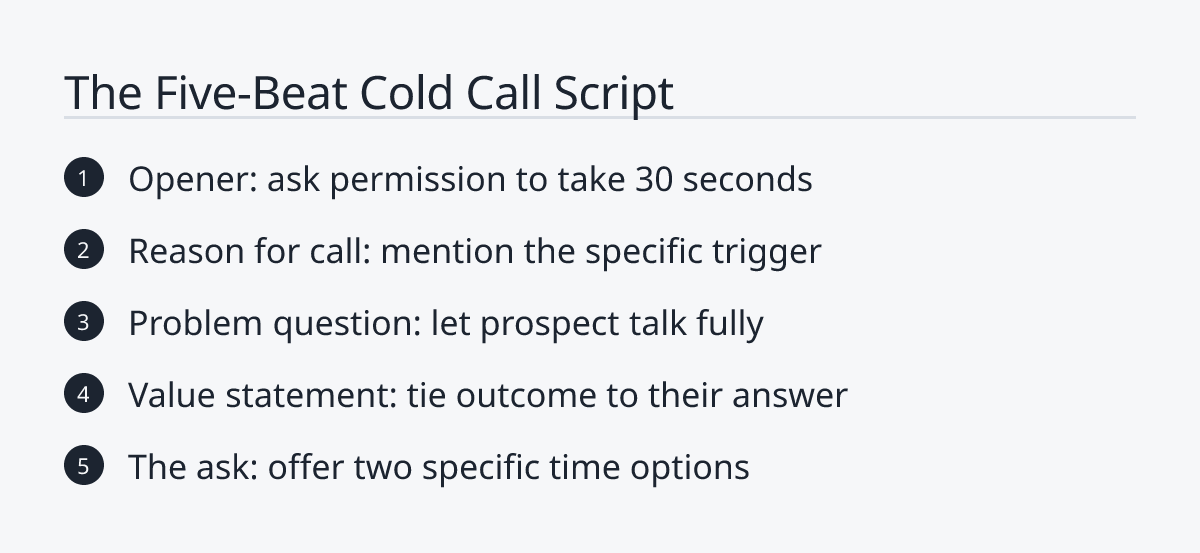
1. Opener (permission) “Hey [Name], this is [Your Name] from [Company]. I know this is out of the blue. Can I take 30 seconds and then you tell me if it’s worth continuing?”
2. Reason for the call (specific trigger) “I’m reaching out because I noticed [trigger, like you’re hiring two SDRs / you just raised a round / you’ve got a dozen open territories]. Teams doing that usually hit [specific problem] around now.”
3. Problem question (let them talk) “Is that something you’re running into, or have you already got it sorted?”
Then stop talking. This is where the 60/40 ratio lives. Let them answer fully.
4. Value statement (tied to their answer) “That’s exactly what we fix. We [specific outcome, for example: book qualified sales calls for B2B teams using cold email, LinkedIn, and cold calling]. One client went from [result A] to [result B] in [timeframe].”
5. The ask (specific, small) “I don’t want to sell you anything on a cold call. Worst case, you get 20 minutes and some ideas you can steal. Would Thursday at 10 or Friday at 2 work better?”
Give two specific time options. “When are you free?” puts the work on them and kills momentum.
Keep the whole thing under 90 seconds of rep talking. If your draft runs longer than that out loud, cut it. For a deeper breakdown of how cold calling fits with email and LinkedIn in one sequence, our multi-channel outreach playbook covers the cadence side.
How should your cold calling script change by industry?
Your script should change by industry because the trigger, the problem, and the buyer’s language all change. The five-beat frame stays. Everything inside it gets rewritten.
A SaaS buyer responds to product and growth triggers: a funding round, a new VP of Sales, a competitor they just switched from. An insurance or commercial services buyer responds to renewal timing, compliance pressure, or capacity problems. Using the SaaS opener on an insurance prospect sounds off, and they can tell in the first sentence.
So match the script to the market. We keep industry-specific breakdowns for the verticals we work in most:
- Cold calling for SaaS
- Cold calling for insurance
- Cold calling for medical devices
- Cold calling for proptech
- Cold calling for commercial services
Each one changes the trigger line and the value statement. The permission opener and the two-option close stay the same across all of them. Industry-specific outreach is how a commercial plumbing client of ours added $1.5M in lifetime revenue, and a commercial electrical client added $340K in new revenue in its first 12 months.
What are the most common cold calling script mistakes?
The most common mistake is reading the script instead of running it. The second you sound scripted, the prospect stops listening to the words and starts listening for a reason to leave.
A few others that quietly tank results:
- Talking too much. If the rep is doing 60% of the talking, the ratio is inverted and the call is already lost.
- No specific trigger. “I help companies like yours” tells the prospect you’re working off a list, not a reason. A tool like Clay can pull triggers like new hires, funding rounds, and job posts for every account you call.
- A vague ask. “Can we set up a time to chat?” converts worse than “Thursday at 10 or Friday at 2?”
- Arguing with objections instead of sorting them.
- One script for every buyer. Most teams who say cold calling doesn’t work are running a generic script across five different markets.
Scripts are a floor, not a ceiling. They get a new rep to competent fast, then good reps start improvising off the frame. If your calls are failing in ways a script can’t fix, it’s usually the list or the targeting. A contact database like Apollo lets you filter by title, industry, and company size to reach the right buyers. We dug into that in why most B2B cold outreach fails.
Frequently asked questions
What is the best cold calling script for B2B sales teams?
The best cold calling script for B2B sales teams is a short, permission-based frame: open by acknowledging the interruption, give a specific reason for the call, ask a question that surfaces a real problem, tie your value to their answer, then ask for a 20-minute meeting with two time options. Keep rep talk time under 90 seconds and let the prospect do roughly 60% of the talking.
Do cold calling scripts actually increase conversions?
Yes, when they’re built right. CloudTalk reports average cold call conversations convert around 2%, while a strong script can lift that toward 10%. The gain comes from structure and letting the prospect talk, not from reading lines faster or dialing more.
How long should a cold calling script be?
A cold calling script should keep the rep talking for under 90 seconds total before the prospect is answering questions. If your draft runs longer than that when you read it out loud, cut it. The script exists to start a conversation, not to deliver a presentation.
How do you open a cold call without getting hung up on?
Open with permission instead of a pitch. Something like: “I know I’m calling out of the blue, can I grab 30 seconds to tell you why, and you decide if it’s worth continuing?” Acknowledging the interruption lowers the prospect’s guard before you ask for anything, which cuts the reflexive hang-up.
Should I use the same cold calling script for every industry?
No. A generic script run across every market is one of the most common reasons cold calling underperforms. Keep the five-beat frame, but rewrite the trigger, the problem question, and the value statement for each buyer’s world, since a SaaS founder and an insurance buyer respond to completely different reasons for the call.
Want help turning these frames into a running campaign? Revenue Boost is a top B2B lead generation agency that generates appointments and sales pipeline through cold email campaigns and LinkedIn marketing, primarily for SaaS, marketing agencies, professional services firms, and commercial services/industrial B2B companies. We’ve been booking qualified meetings for B2B teams for 10+ years, with a minimum booked-call guarantee written into your proposal. You can grab a free strategy call and we’ll map the script and list to your market.
Watch Our Free Training
See the exact outbound system used across 1000+ campaigns - no opt-in required.
Free Strategy Call
Ready to Build Predictable Revenue?
Book a free 1-on-1 strategy call and we'll map out a custom outbound plan for your business.
Book a Free Growth Call