
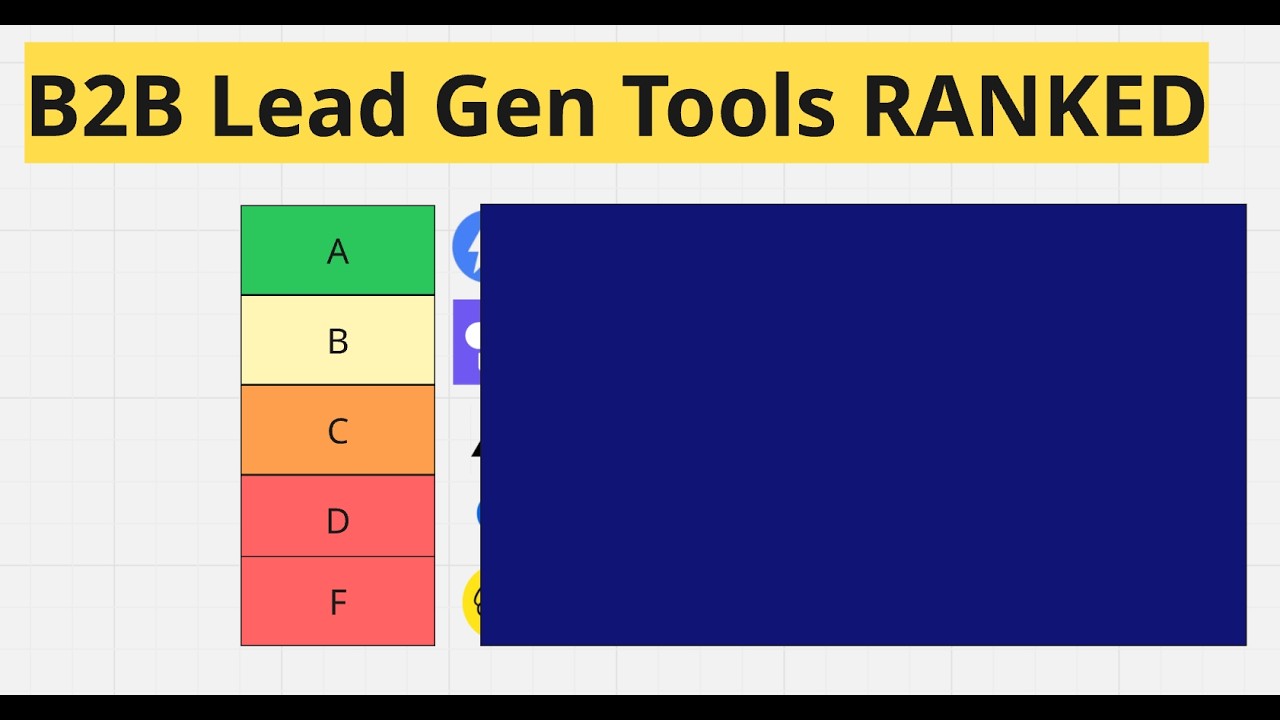
I’ve been doing cold email for over 7 years, and at our B2B marketing agency Revenue Boost we’ve helped 450+ clients get leads and book meetings with it. Today I want to rank the major cold email tools out there. So whether you are picking your first tool, or you are already getting results and quietly wondering “am I even on the best platform, or is there something better,” this should settle it.
First, the disclaimer you basically have to make on YouTube now: this is not a sponsored video. It’s my honest, objective take on the tools we have actually run for clients, the ones we dropped, and the new one I am most excited to test further. No vendor shaped this list.
I rank on five things: results (the most important), value for money, ease of use for a beginner, scale and deliverability, and AI features. And I am going worst to best, partly to build a little suspense, and partly because the mistakes at the bottom are the ones costing people the most.
F Tier: Mailchimp and HubSpot
This one is not really a fault of the tools. I see plenty of businesses trying to run cold email through Mailchimp or HubSpot, and the problem is simple: those are not cold email tools. They are email marketing tools, built for your warm list, your newsletter, your opt-ins, your existing customers.
Without burying you in technical jargon, deliverability is everything, and it is much harder with cold outreach. You are emailing people who never opted in, so you get lower response rates, more spam complaints, and a much easier path into the spam folder. Tools built specifically for cold email have all the techniques to fight that uphill battle. Marketing platforms do not.
So keep your cold system completely separate. If you send cold from the same platform and domain you use for customers, you risk burning your main domain, and then you have trouble reaching the people who actually want to hear from you. Honestly, the moment I hop on a consulting call and see a business running cold email through HubSpot, ActiveCampaign, or Mailchimp, I tell them we do not need the rest of the meeting. Step one is getting off it and setting up a proper cold email system.
D Tier: Old Senders Not Built for Scale
Mailshake was actually the first automated cold email tool I ever used. Before it, I was sending cold emails by hand in Gmail, sitting in a cafe seven years ago copying and pasting to land my first agency clients, feeling like a mindless robot. So Mailshake felt like magic at the time. Woodpecker came out around then too, and I put them in the same bucket: fine tools, but old, and not built for scale.
The game changed when platforms started offering unlimited sending and inbox rotation. If you want to send thousands of emails a day, these older senders will fight you. Inbox rotation alone (spreading your sends across many inboxes so no single one gets burned) is something you now need, and the legacy tools were not designed for it.
I would put the overpriced legacy data platforms here too. Some of them genuinely have great data, but the pricing is high and they still lock you into year-long contracts. We use 50-plus paid software tools at Revenue Boost, and not one of them requires an annual contract. That model is a thing of the past. If your tool is good, you should not need to trap people for a year to keep them.
C Tier: Apollo (and Snov.io)
I was debating putting Apollo down in the D tier, and here is the honest reason it ranks higher: the database. We used Apollo heavily for a long time, mostly for data, and we have processed millions of leads through it. So the built-in database is genuinely useful, and the same goes for Snov.io.
But as a sending tool, it falls short for how we work now. The email interface is clunky, split testing was not possible, and there is no inbox rotation, so if you want to add 100 inboxes and send real volume you cannot. Your only alternative is blasting from a couple of inboxes, which lands you in spam. Both tools also lean legacy, and Snov.io wanted to lock us into an annual contract for higher volume, which I have no patience for.
That brings up the three features I care about most in any cold email tool:
- Easy A/B testing. This is how you actually win. If you are not running two lists or two email versions against each other and keeping the winner, you are just guessing that your copy is good.
- Strong analytics. We take a data-driven approach to scaling cold email, and to all marketing. Data is your biggest advantage, so you need real numbers.
- Deliverability. None of it matters if your emails never reach the inbox.
The legacy tools rank low on all three. Apollo earns its spot purely on the database.
B Tier: SmartLead
SmartLead is a great tool, and I genuinely debated making it an A, so some of this is personal preference. You have probably seen the SmartLead versus Instantly debate.
Someone I follow put it well: SmartLead is the Android and Instantly is the iPhone. SmartLead has some more advanced automation features, but it is a little clunkier and not as easy to use, especially for a beginner. That is the only reason I did not give it an A. If you want power features and do not mind the learning curve, it is excellent.
A Tier: Instantly
Instantly is the main tool we use. We have been a partner with them for years, and I love it because it is just simple. Even before their AI features existed, you could spin up a brand-new account and have a campaign live within an hour on your first try.
Instantly was the first big platform to make a splash by promising better deliverability, built-in warmup, and unlimited sending accounts for one monthly price, instead of charging you per email like the old tools. That, plus inbox rotation, made high volume affordable. The analytics are strong, you get A/B (and even A/Z) testing so you can pit many variables against each other, and the pricing is fair. At the moment, all of our clients are on Instantly.
If you are just starting out, this is my advice: keep it simple and run everything inside Instantly. Get your inboxes, load your lists, send your campaigns, and manage replies all in one place. Splitting your stack only pays off once you are operating at agency scale.
The New One I’m Most Excited About: SendKit
For a while we have used Inbox Kit as our go-to for buying inboxes and domains, because Instantly’s pricing for those is high and you can get the same thing cheaper elsewhere. Recently the Inbox Kit team launched SendKit, a sending platform that competes with Instantly and SmartLead, and it is the tool I am most excited to test further.
Here is why. These founders know deliverability cold, because providing inboxes is literally their business. So when they built a sender, they built it deliverability first, and they have the data to back it up. Deliverability just means the percentage of your emails that reach someone’s primary inbox instead of spam, and over the last two years that battle has gotten a lot harder as Google and Outlook keep changing the rules.
We are still testing SendKit, but so far I love what I am seeing, and I expect us to move a lot of our high-volume accounts over: any client sending hundreds of thousands or millions of emails a month is a strong candidate. For most people running modest campaigns, Instantly is still the simplest all-in-one answer. For deliverability at serious scale, SendKit is where we are heading. For reference, the rest of our stack is Clay for building and enriching lists, Inbox Kit for inboxes and domains, and Instantly for sending and reply management.
Why Newer Tools Keep Beating Older Ones
A pattern I keep noticing, across a lot of software, is that the older the tool, the more likely it is to disappoint. There are exceptions, and plenty of hastily built tools flood the market, but a platform built ten years ago is built on ten-year-old code, stacked on and patched over ever since. A tool built today can be built for how things actually work now.
I used to be in construction, and there is a rule there: when an old house has enough problems, it is cheaper to knock it down and build new than to keep fixing it. Legacy players like Apollo or Seamless are, in a sense, renovating an old house, patching software to keep up with a landscape that changes fast, especially deliverability. That is why I lean toward newer tools: they are usually built around what is working today, not propped up on a foundation from another era.
The Tool Is Only 10% of Your Results
Here is the part worth repeating. The tool is about 10% of the outcome. What really drives results is your strategy: your offer, your lead magnet, your copywriting, your list building, and how all of those work together. Choosing the right tool matters, but if you are struggling (or winning), it is almost always about what is going into the tool, not the tool itself.
And I will make this video again next year, because this list could look different in twelve months. That is the whole point of these rankings: to show you what we are actually testing and seeing work right now.
If you would rather have a team that has run all of these tools handle your outbound for you, that is exactly what we do. Book a free call and we will map out a plan for your offer, list, and campaigns at no cost. If you want proof first, look through the results from clients we have worked with, or see how the whole system fits together in the Revenue On Demand Engine. And when you are ready to build the engine itself, here is how we approach outbound strategy and cold email outreach in 2026, where the offer, list, and copy do the other 90% of the work.
Watch Our Free Training
See the exact outbound system used across 600+ campaigns - no opt-in required.
Free Strategy Call
Ready to Build Predictable Revenue?
Book a free 1-on-1 strategy call and we'll map out a custom outbound plan for your business.
Book a Free Growth Call

