Every agency owner I talk to is quietly asking the same question right now: is AI going to put me out of business? A business owner can open ChatGPT and, in about 30 minutes, have cold emails, social posts, a homepage, a marketing plan, and market research. So what exactly is left for the rest of us to sell?
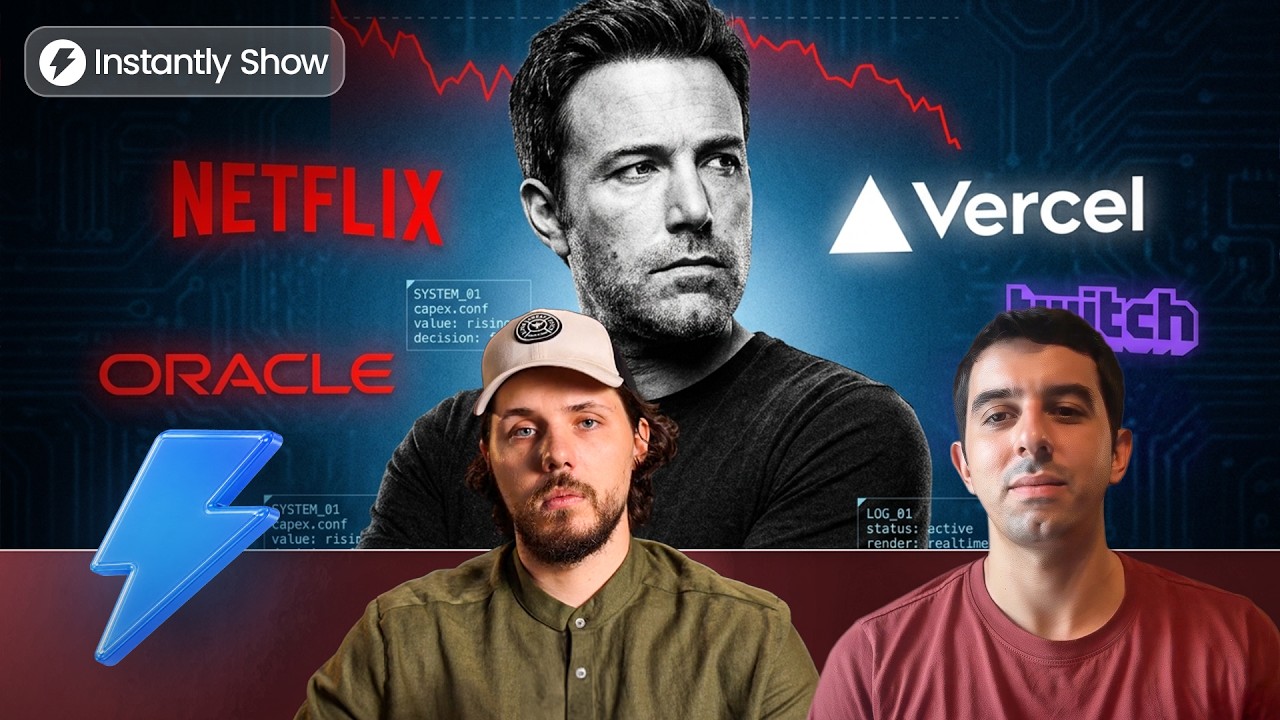
I went on The Instantly Show recently to dig into that, along with how I think about scaling an agency in 2026, where cold outbound still fits, and why buyers are starting to find us through ChatGPT and Claude instead of Google. We’ve helped over 450 B2B companies build pipeline at Revenue Boost, and my honest take is that agencies aren’t going anywhere. But the ground underneath them is shifting, and one kind of agency is in real trouble.
Here’s how I’m thinking about all of it.
AI Won’t Kill Agencies. It’ll Kill One Kind of Agency.
The barrier to producing marketing deliverables has basically collapsed. Any business can now go to ChatGPT and get cold emails written, social posts drafted, or a website spun up. That’s real, and it isn’t reversing.
Here’s the catch, though. If any business can get their cold emails and social posts written by ChatGPT, then every other business is doing the exact same thing, and everyone produces the same stuff. It’s why so many websites now look identical: the same AI stock look, the same copy, the same photos. It’s why so many cold emails you get follow the same patterns. When everyone has the same tool, the output regresses to the same average.
So the deliverable itself is no longer the product. Which leads to the one honest test for any agency: look at the work you do for clients and ask whether ChatGPT can produce the same quality. If it can, you’re in trouble and you need to raise your game. If your work is genuinely better because you’re doing the strategy, the market research, and the thinking, then you’ll be fine. You might still have to handle the objection on sales calls, because some clients will believe they can do it themselves, and you need to be ready to talk about that. But the agency isn’t what’s at risk. The commodity version of it is.
The Two Things AI Still Can’t Do
When people push me on this and say, sure, but what about three or four years from now when the agentic systems are far better and can run the research and assemble world-class campaigns on their own, my answer doesn’t change. There are two things AI doesn’t do, and I haven’t seen anything shift that.
The first is original ideas. AI works off pattern recognition from things that already exist. I don’t know a single person who has had AI invent a genuinely new solution to a problem nobody knew they had. It remixes what’s out there. Coming up with the idea in the first place, knowing what work should even be done, is the actual value of a consultant or an agency, and AI doesn’t originate it.
The second is quality control. We’ve all asked AI to make something, a cold email campaign or whatever it is, and gotten back something mediocre, or flat wrong, or hallucinated. Most of the time it’s good. But occasionally it’s bad, and you only know the difference if a professional is looking over it. The people who study how these models are built will tell you that you can’t fully solve hallucination. There’s always some percentage of it. That alone guarantees you need a human in the loop managing and checking the work, indefinitely.
So as AI improves, it will keep absorbing more of the tasks inside the workflow. That’s fine. It just means agencies have to deliver more value than the tasks AI now does for free. The idea generation at the front and the quality control at the end are the parts I don’t see going anywhere.
Deliverables Get Commoditized. Owning the Result Doesn’t.
This splits agencies into two camps, and it’s a split that existed long before AI. There have always been agencies that just load up Instantly, spin up inboxes and domains, write some quick copy, and check a box. And there have always been agencies that do all that plus the real market research: spotting patterns across industries, building the offer and the lead magnet, and analyzing the client’s sales process to see whether they could be converting more of the leads we’re already sending them. One type produces deliverables. The other owns a business result.
The deliverable shops have always struggled more than the result shops. AI just widens the gap. AI will help you produce deliverables. It won’t achieve the entire business result for a client, because that takes domain expertise it doesn’t have.
The same logic makes the case for becoming a more holistic growth partner. If you can run cold email, help with the website, shape the creative strategy, and produce video, it’s much harder for AI to coordinate all of that well, which makes you safer. That said, you don’t have to be a full-service shop to survive. A single-lane agency that only does cold email can absolutely thrive, as long as it’s doing the strategy and not just the sending. The word that keeps coming up is strategy, because that’s where the value actually lives.
The Agency Models Most at Risk
If I had to point at what’s most exposed, it’s the work that’s manual, monotonous, and linear. Think basic SEO, or coding simple three-to-five-page websites where you’re not really doing the branding, positioning, or creative. Those workflows are the easiest for AI to eat, and tools like Lovable, and now even Claude, can stand up a website for you.
But even there, it’s not a clean replacement. Anyone getting genuinely good results from an AI-driven SEO process is usually a strong SEO team already, because they know what good looks like and how the tool should be run. You still need an expert behind the wheel, and you still need experts to build these tools in the first place. So yes, the more linear your workflow, the more at risk you are, but the strategy and QC layer never fully disappears.
Scaling Is a Different Kind of Hard at Every Stage
People ask whether it’s harder to take an agency from zero to $50k a month or from $50k to $200k. They’re just different kinds of hard.
Zero to $50k is more brute-force hard work, because everything falls on you: marketing, sales, finance, finding product-market fit. You force your way to six figures. Past that, it becomes a different kind of hard. Now it’s about managing and leading people, which is its own skill set, and about thinking more strategically. It sounds cliche, but it’s the shift from working hard to working smart. When you do everything yourself, you have to work insane hours just to keep up. When you have a team, you shouldn’t be grinding 80-hour weeks. You should be slowing down, thinking, supporting your people, and innovating the business, and you need a clear head for that. Overall, things get easier as you grow, because more money lets you hire smart people to solve problems instead of carrying all of it on your own shoulders.
Stop Picking a “Best Channel.” Build an Acquisition Ecosystem.
A lot of people freeze trying to pick the one perfect marketing channel. That’s the wrong frame. Paid ads, organic content, and cold outreach all work. They just have different pros, cons, and purposes. Any company that keeps scaling ends up with some mix of all three. We call that the acquisition ecosystem.
If you’re early, the first channel I’d build is cold outbound, because it’s the most cost-effective way to start. Ads are the most capital-intensive, so they usually come later. And the way we run ads now isn’t direct cold traffic at all. It’s ads pointed at our best-performing organic posts, the ones that already worked, with a CTA added. That way paid spend amplifies the brand instead of just renting attention that disappears the day you turn it off.
The move is to pick one channel, master it, and move to the next based on the stage you’re at. Not to gamble everything on finding a single perfect one.
Getting Found in ChatGPT and Claude
Something new is happening: we’re getting clients who found us by asking ChatGPT or Claude for a B2B marketing agency or a cold email expert. I’m not an SEO expert, I have a team for that, but here’s what I’ve observed.
The fundamentals are largely the same as ranking on Google. You don’t need to throw out your strategy, you just need to start tracking whether you show up in the LLMs too. What has clearly helped me is going beyond my own website. I do a lot of guest podcasts, this is my fourth time on the Instantly channel over the years, and I speak on virtual and in-person stages. The last data I saw had the top three sources these models pull from as LinkedIn, Reddit, and YouTube, so those are the places to make sure you exist. The LLMs look at the whole internet, not just your homepage, which means being cited by other people and showing up across podcasts and events matters more than it used to.
A Few Hard-Won Opinions
Some rapid-fire takes from the conversation:
- Offer beats acquisition strategy, every time. If you have the best offer in the world, that is your acquisition strategy. You can put it almost anywhere and it should work.
- Retainer over performance-based, or a retainer-plus-performance hybrid. Pure performance puts all the risk on you. It’s easier to sell, but it’s not as good a business model.
- The subject lines that still get me are the ones that reference something specific from my website or a recent LinkedIn post. Using the keywords from something I actually published is what cuts through.
- Do I still write the cold emails myself? My team handles it, AI-assisted, and we built our own copywriting bot with Claude. But we never let it write everything. A human comes up with the idea and checks the final product.
- Would I start an agency in 2026? Yes, without hesitation. It’s never too late for good agencies. For a first business, a service business beats e-commerce, software, or a physical location. The first couple of times I did this, we hit $30k to $50k a month within three to six months. It’s profitable, it cash-flows well, and if you do good work you keep clients for a long time.
The Throughline
Everything above rhymes. AI commoditizes the doing, so the value moves to the thinking: the ideas, the strategy, the offer, and the judgment to know when the work is actually good. Build an acquisition ecosystem instead of betting on one channel, start with cold outbound because it’s the cheapest to stand up, use ads to amplify what’s already working, and make sure you show up where buyers and the AI models are now looking. The agencies that own results instead of shipping deliverables are the ones that keep winning. That has always been true. AI just turned up the volume on it.
If you want help building a predictable pipeline without relying on ads or funnels, that’s exactly what we do. Book a free call and my team and I will put together a personal go-to-market plan and outbound strategy at no cost. If you’d rather see proof first, look through the results from clients we’ve worked with, or see how we structure the whole system in the Revenue On Demand Engine. And if you want to start where I’d start, here’s how we run outbound strategy and cold email outreach in 2026.
Watch Our Free Training
See the exact outbound system used across 600+ campaigns - no opt-in required.
Free Strategy Call
Ready to Build Predictable Revenue?
Book a free 1-on-1 strategy call and we'll map out a custom outbound plan for your business.
Book a Free Growth Call